

Quick answer: EuroLeague is Europe’s premier professional basketball competition featuring 18 elite clubs from across the continent. The season runs from October to April with a double round-robin regular season, followed by a best-of-five playoff series for the top eight teams, culminating in a single-elimination Final Four to determine the champion. Understanding its structure helps players engage with related iGaming content more knowledgeably. Key takeaways: – EuroLeague regular season features 34 games per team in a home-and-away format – Playoffs use a best-of-five series format for quarterfinals and semifinals – Final Four is a single weekend with two semifinals and a final – No team is guaranteed advancement; outcomes depend on performance each game – Always check current tournament rules and play responsibly
Setting the scene: your phone lights up at 9:30 PM
Imagine it’s raat ke 9:30 baje, you’re scrolling through sports apps after dinner, and you see EuroLeague matchups flashing across your screen. You tap on a game between Anadolu Efes and FC Barcelona, curious about how this European competition actually works before deciding whether to engage with any related content. Before you go further, let’s pause for 30 seconds — kya aapne 30 second ka pause liya? This guide won’t give you shortcuts, sure-shot predictions, or guaranteed outcomes. Instead, it explains how EuroLeague functions: its regular season, playoffs, and Final Four structure — so you can evaluate any platform or information source with clarity.
What is EuroLeague and why it matters
EuroLeague is the top-tier professional basketball club competition in Europe, organized by EuroLeague Basketball. It features 18 teams that earn participation through a combination of historic standing, wildcard entries, and performance in domestic leagues or qualifying tournaments. Unlike national team competitions like FIBA EuroBasket, EuroLeague focuses exclusively on club basketball, mirroring the structure of UEFA Champions League in football but for basketball.
Understanding its format matters because iGaming platforms often offer markets related to EuroLeague games — match winners, point spreads, over/under totals, and outright tournament outcomes. Knowing whether a team is in the regular season fight for a playoff spot or battling in a best-of-five series helps contextualize odds, volatility, and what factors might influence performance. Remember: odds and RTP reflect long-run averages across thousands of games; they never guarantee results in any single session.
The 30-Season Structure Check: How EuroLeague actually works
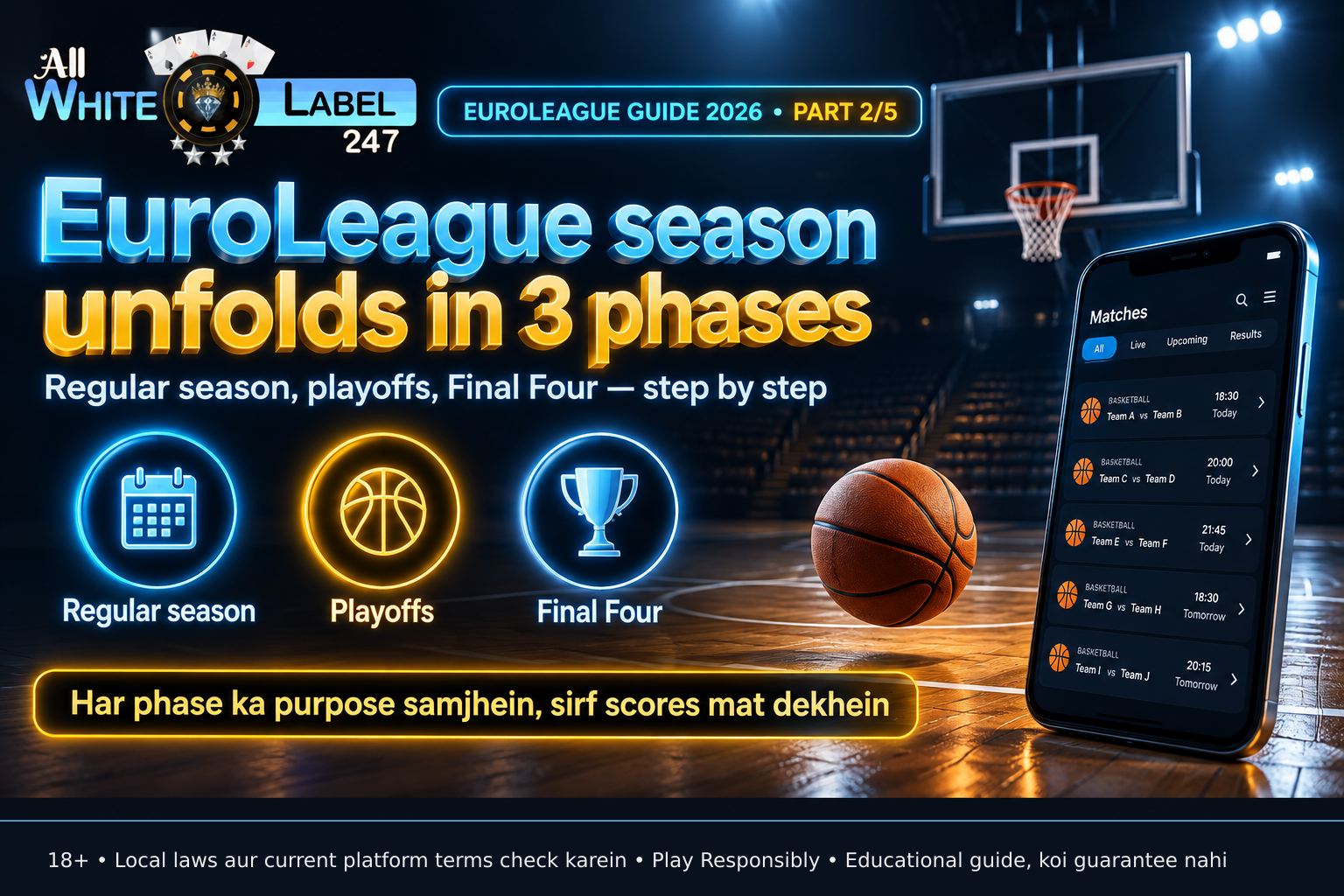
Here’s how the competition breaks down into three clear phases, each with distinct rules and implications:
1. Regular season: the 34-game grind
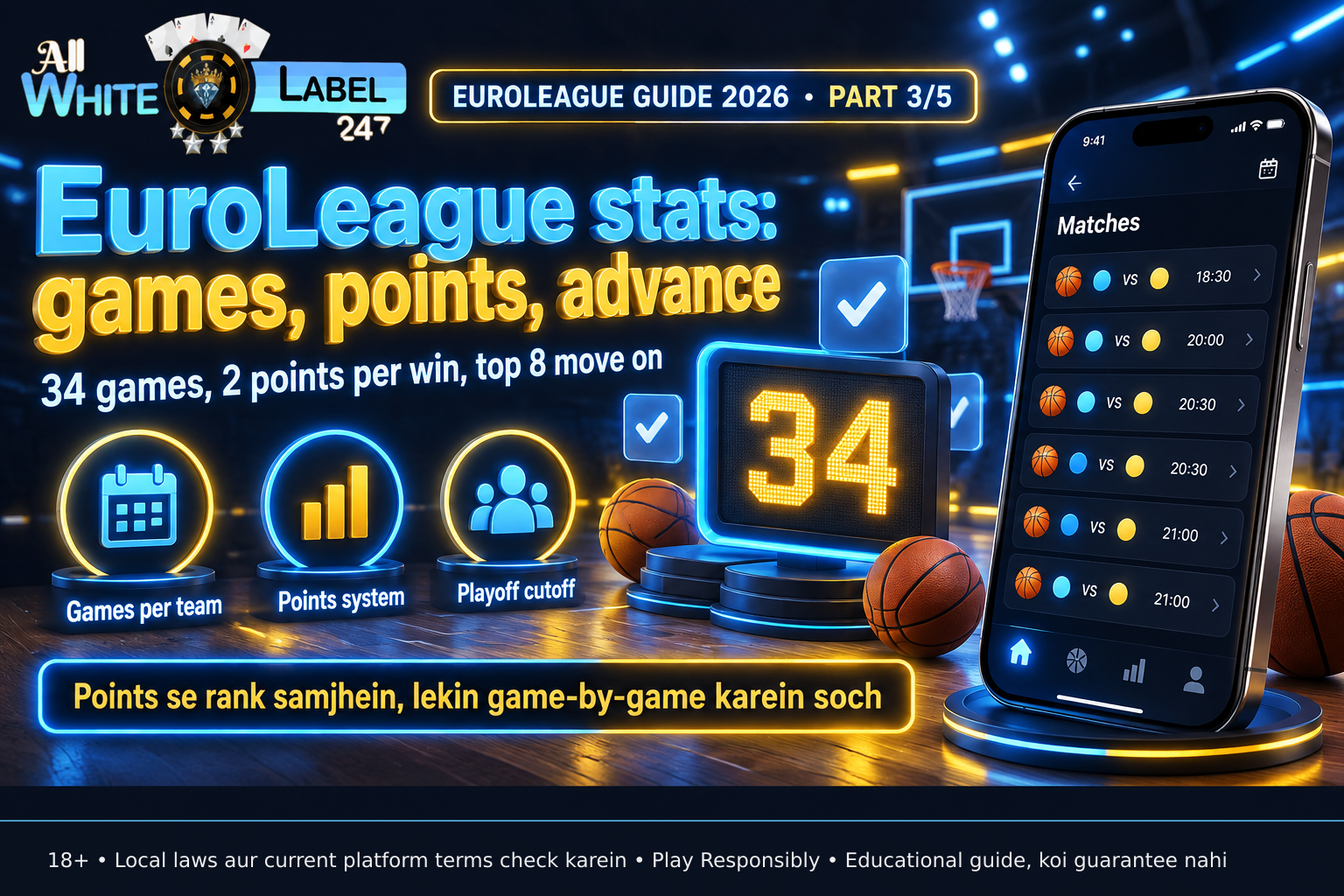
The EuroLeague regular season consists of a double round-robin format where each of the 18 teams plays every other team twice — once at home and once away. This results in 34 games per team (17 opponents × 2 games). The season typically runs from early October to mid-April, with games scheduled midweek to avoid clashes with domestic league weekends.
Teams earn points as follows: win = 2 points, loss = 1 point (no overtime losses in regulation standings; overtime results still count as wins/losses for points). The top eight teams at the end of the regular season advance to the playoffs. Teams ranked 9th–18th are eliminated, with no relegation to a secondary competition — EuroLeague membership is multi-year based on licensing and performance criteria.
Example: If Team A finishes with an 18–16 record (36 points) and Team B finishes 17–17 (35 points), Team A would likely secure a playoff spot over Team B, assuming tiebreakers don’t intervene. Tiebreakers consider head-to-head record, then point differential in those games, then overall point differential.
2. Playoffs: best-of-five series
The playoffs begin with the quarterfinals, matching the 1st vs 8th, 2nd vs 7th, 3rd vs 6th, and 4th vs 5th seeds from the regular season. Each series is played in a best-of-five format — first team to win three games advances. The higher-seeded team holds home-court advantage, hosting Games 1, 2, and 5 (if needed), while the lower seed hosts Games 3 and 4.
There are no byes or reseeding; the bracket remains fixed. If a series reaches 2–2, Game 5 is played at the higher seed’s venue. The four quarterfinal winners advance to the semifinals, which follow the same best-of-five structure, re-seeded only by original regular-season ranking (1–4 vs 5–8 would not happen; it’s 1/8 winner vs 4/5 winner, etc.).
Example: In a 2–2 series tie, Game 5 becomes critical. Suppose Team X (higher seed) wins Game 5 at home by 8 points — they advance regardless of regular-season point totals. No "momentum" carries over statistically; each game is an independent event governed by player performance, coaching adjustments, and in-game variables.
3. Final Four: the weekend showdown
The Final Four is a single-elimination tournament held over a weekend (typically Friday and Sunday) at a predetermined neutral venue. The two semifinal winners from the playoffs meet in one semifinal, while the other two playoff victors meet in the second. The winners of those semifinals clash in the final; the losers play a third-place game.
Unlike the playoffs, there are no series — just one game per matchup. The venue changes annually (recent examples: Berlin, Belgrade, Ljubljana), and tickets are sold separately from regular-season or playoff games. Winning the Final Four crowns the EuroLeague champion for that season.
Example: In 2023, Real Madrid defeated Olympiacos in the final after both teams won their respective semifinals. Had Olympiacos won Game 1 of their semifinal series but lost the next three, they would not have reached the Final Four — demonstrating how playoff series performance, not single-game results, determines qualification.
How the mechanism compares: EuroLeague vs. NBA vs. FIBA
Understanding where EuroLeague fits in the global basketball landscape helps clarify its unique stakes. Below is a comparison of key structural elements:
| Feature | EuroLeague | NBA | FIBA National Teams (e.g., EuroBasket) |
|---|---|---|---|
| Participant type | Club teams | Club teams | National teams |
| Number of teams | 18 | 30 | 24 (EuroBasket) |
| Regular season format | Double round-robin (34 games) | 82 games per team | Single group stage + knockout |
| Playoff advancement | Top 8 to best-of-five series | Top 16 to best-of-seven series | Top 8 to single-elimination knockout |
| Finals format | Single-game Final Four | Best-of-seven series | Single-game final |
| Governing body | EuroLeague Basketball | NBA | FIBA |
This table shows EuroLeague blends elements: its regular season is longer than FIBA tournaments but shorter than the NBA, while its playoff series length (best-of-five) splits the difference between the NBA’s best-of-seven and FIBA’s single-elimination knockouts. The Final Four’s weekend format is unique — no other major basketball competition uses a single-venue, single-elimination weekend to conclude its season.
Device and account security: your 30-second safety check
Before engaging with any EuroLeague-related content on a platform, run this quick verification — think of it as fastening your seatbelt before driving:
- Verified web address: Confirm the URL starts with
https://and matches the official platform domain (check for subtle misspellings like.c0minstead of.com) - HTTPS active: Look for the padlock icon in your browser’s address bar — never enter details on HTTP-only sites
- 2FA enabled: Use two-factor authentication (via authenticator app or SMS) on your account — never share OTPs or PINs
- No shared credentials: Never lend your login details, even to friends or family
- APK caution: Only download apps from official stores (Google Play, Apple App Store); avoid unverified third-party APKs claiming "EuroLeague tips" or "guaranteed wins"
These steps protect your data and account integrity. They do not influence game outcomes or improve odds — they simply reduce risks of unauthorized access or phishing.
Common mistakes to avoid
- Assuming regular-season form predicts playoffs: A team that dominated the regular season can lose a playoff series due to matchup issues, injuries, or tactical adjustments — past performance doesn’t guarantee future results in a best-of-five format.
- Confusing EuroLeague with EuroBasket: EuroLeague is club-based; EuroBasket features national teams. Mixing them up leads to misunderstanding qualification paths and player availability.
- Overvaluing single-game results in playoffs: In a best-of-five series, losing Game 1 doesn’t eliminate a team — they still need to win three total. Avoid reacting to early-game volatility as if it decides the series.
- Believing Final Four venue affects odds inherently: While travel and crowd factors play a role, the neutral venue is designed to minimize home-court advantage. Check actual team stats, not just the location.
- Treating any stage as "fixed" or "predictable": No game, series, or tournament outcome is certain. Odds reflect probabilities, not certainties — always play responsibly and within pre-set limits.
Quick pre-session checklist
Use this table before engaging with EuroLeague content to verify your readiness:
| Check | Action | Status (✓/✗) |
|---|---|---|
| 18+ confirmation | Verify age per platform terms | |
| Budget set | Decide session limit beforehand | |
| 2FA active | Check authenticator app/SMS setup | |
| Official URL | Confirm HTTPS and correct domain | |
| No shared login | Ensure credentials are private | |
| Responsible play reminder | Recall: play for fun, not income |
Brand section: what you should verify
As this is a white-label explainer for allwhitelabel247.io, no specific brand offers, features, or sister sites are detailed here. For any platform-related information — such as current withdrawal times, bonus terms, or licensing details — always check the official terms and conditions page of the specific operator you are using. Verify licensing information directly with the relevant regulator’s public registry. Remember: any mention of promotions is subject to their full terms.
Call to action
Explore EuroLeague matchups with awareness — check official sources, set limits, and play responsibly.
FAQ
What is the EuroLeague regular season format? The EuroLeague regular season uses a double round-robin format where each of the 18 teams plays every other team twice — once home and once away — resulting in 34 games per team. Wins earn 2 points, losses earn 1 point, with the top eight advancing to the playoffs based on total points.
How do EuroLeague playoffs work? The playoffs feature a best-of-five series format for quarterfinals and semifinals. The higher-seeded team hosts Games 1, 2, and 5 (if needed), while the lower seed hosts Games 3 and 4. First to three wins advances; there is no reseeding between rounds.
What is the Final Four in EuroLeague? The Final Four is a single-elimination tournament held over a weekend at a neutral venue. The four playoff winners compete in two semifinals on Friday, with the winners meeting in the final on Sunday (and losers playing for third place). The victor is crowned EuroLeague champion.
Is EuroLeague the same as EuroBasket? No. EuroLeague is a club competition featuring professional teams like Anadolu Efes and FC Barcelona. EuroBasket is a national team tournament where countries like Spain, France, and Serbia compete — players represent their nations, not their clubs.
Do home-court advantages exist in EuroLeague playoffs? Yes. In each best-of-five playoff series, the team with the better regular-season record gets home-court advantage, hosting Games 1, 2, and 5 (if necessary). The opponent hosts Games 3 and 4. Advantage resets per series based on seeding.
Can a team be relegated from EuroLeague? Not based on seasonal performance alone. EuroLeague participation is granted through multi-year licenses tied to sporting performance, arena standards, and financial stability — poor one-season results don’t automatically trigger relegation, though they may affect license renewal.
How long does a EuroLeague season last? The regular season runs from early October to mid-April, followed by playoffs in April and the Final Four in late May or early June. The exact dates vary slightly each season based on calendar scheduling.
Are EuroLeague games affected by player fatigue from domestic leagues? Possibly. Many EuroLeague players also compete in their domestic leagues (e.g., Liga ACB in Turkey, BBL in Germany), leading to congested schedules. However, impact varies by squad depth, rotation policies, and individual player management — it’s never a guaranteed factor.
Where can I check official EuroLeague rules and schedules? Visit the official EuroLeague Basketball website (euroleague.net) for the most current rules, fixture lists, and tournament regulations. Always cross-check with platform-specific terms if engaging with related content.
Does winning the EuroLeague regular season guarantee playoff success? No. Finishing first in the regular season grants home-court advantage throughout the playoffs but does not guarantee winning the title. Playoff outcomes depend on series performance, adjustments, injuries, and matchup dynamics — regular-season ranking is just one factor.
What happens if two EuroLeague teams finish with identical records? Tiebreakers are applied in order: head-to-head record between the tied teams, point differential in those games, then overall point differential for the season. If still tied, further criteria like points scored or fair play conduct may be used per official regulations.
Is there a third-place game in the EuroLeague Final Four? Yes. The two semifinal losers play a consolation game on the same day as the final to determine third and fourth place. This game is officially recognized but does not affect the championship outcome.
Can I rely on past EuroLeague results to predict future outcomes? No. While historical data informs probabilities, each game, series, and season is independent. Past performance never guarantees future results — always evaluate current form, rosters, and conditions, and play responsibly within set limits.
Why does EuroLeague use a best-of-five playoff format instead of best-of-seven? The best-of-five format balances competitive intensity with scheduling feasibility. It allows for meaningful series resolution while accommodating the dense calendar of club basketball, where players often have domestic league and cup obligations.
Final takeaway
EuroLeague offers a structured, multi-stage basketball competition where understanding the regular season, playoff series, and Final Four format helps contextualize any related content — always verify details through official sources and play responsibly.
Related reading
- Why in-play odds move so fast 2026 (allwhitelabel247.com)
- India’s Badminton Circuit Explained: BWF Tour Levels and How Rankings Are Earned 2026 (allwhitelabel247.com)
- Anant Chaturdashi 2026: What It Means for iGaming Operators in India (allwhitelabel247.com)
- Setting deposit and time limits 2026 (allwhitelabel247.com)