

AllWhiteLabel247: The Complete White Label Sports Betting Platform for Modern Gaming Businesses
Running a successful sports betting business involves much more than simply launching a website. Operators often struggle with managing multiple admin panels, handling customer accounts, processing settlements, tracking agents, maintaining accurate ledgers, and monitoring live betting activity. As businesses grow, these manual processes become time-consuming and increase the risk of operational errors. AllWhiteLabel247 is designed to simplify sportsbook operations by providing a centralized platform that brings administration, automation, reporting, and user management together in one place. Whether you’re starting a new betting business or expanding an existing operation, the platform offers the tools needed to streamline day-to-day management. What is AllWhiteLabel247? AllWhiteLabel247 is a comprehensive white label sportsbook platform that provides businesses with ready-to-launch betting solutions, centralized management tools, and scalable infrastructure. Instead of building everything from scratch, operators receive a complete ecosystem that includes sportsbook management, user administration, reporting, APIs, and automation features. The goal is simple: Common Challenges for Betting Operators Many sportsbook businesses begin with spreadsheets, messaging apps, and multiple independent admin panels. While this may work initially, operations become increasingly difficult as the customer base grows. Common operational challenges include: As these issues grow, they can impact customer experience and overall operational efficiency. A Centralized Management System One of the biggest advantages of AllWhiteLabel247 is its centralized dashboard. Rather than switching between several platforms, administrators can access key operational data from a single interface. The centralized system helps manage: Having a unified dashboard allows teams to respond more quickly and maintain better visibility across the business. Four Core Pillars of the Platform 1. Single Dashboard All important information is available from one central interface. Instead of opening multiple systems, administrators can monitor operations through a unified dashboard. Benefits include: 2. Real-Time Data Synchronization The platform synchronizes operational data across connected modules. This helps ensure that updates made within the system are reflected consistently throughout the platform, reducing duplicate work and improving reporting accuracy. 3. Role-Based Access Control (RBAC) Different team members require different levels of access. Role-Based Access Control allows businesses to assign permissions according to responsibilities. Examples include: This structured hierarchy improves both security and operational control. 4. Automation Automation reduces repetitive manual work by handling predefined operational tasks. Examples include: Automation helps improve efficiency while reducing the likelihood of manual errors. Centralized System vs Multiple Admin Panels Many traditional betting businesses rely on several disconnected management systems. This often results in: A centralized platform offers a unified approach that can simplify management and improve operational consistency. White Label Sports Betting Solutions AllWhiteLabel247 supports businesses looking for ready-made sportsbook infrastructure. The platform is designed for operators who want to focus on business growth instead of building technical systems from scratch. Typical capabilities may include: The exact feature set depends on the selected deployment and configuration. Scalability As betting businesses grow, operational requirements become more demanding. A scalable platform should be capable of supporting: Centralized management makes future expansion easier than maintaining several disconnected systems. Security and Access Management Security is an important aspect of any online platform. Role-based permissions, controlled access, activity logs, and administrative oversight help organizations manage operations more securely while reducing unauthorized access. Reporting and Analytics Good decisions require reliable information. A centralized reporting system helps operators monitor: Having data available in one place simplifies day-to-day management. Why Businesses Choose Centralized Platforms Businesses often move from manual processes to centralized systems because they want to: Frequently Asked Questions What is a white label sportsbook? A white label sportsbook is a ready-to-launch betting platform that allows businesses to operate under their own branding without developing the technology from scratch. What is centralized management? Centralized management means controlling multiple business functions through a single administrative dashboard instead of several independent systems. What is RBAC? Role-Based Access Control (RBAC) allows administrators to assign different permissions to different users based on their responsibilities. Why is automation important? Automation helps reduce repetitive manual work, improves operational consistency, and allows teams to focus on higher-value tasks. Can the platform scale as a business grows? A centralized architecture is designed to support increasing numbers of users, staff, and operational requirements more efficiently than fragmented systems. Conclusion Managing a sportsbook business becomes increasingly complex as operations expand. A centralized platform like AllWhiteLabel247 brings administration, reporting, user management, automation, and operational visibility together in one place. By reducing manual processes and improving workflow efficiency, businesses can focus more on growth, customer service, and long-term scalability.
Admin Panel Features Every Betting Operator Needs in 2026
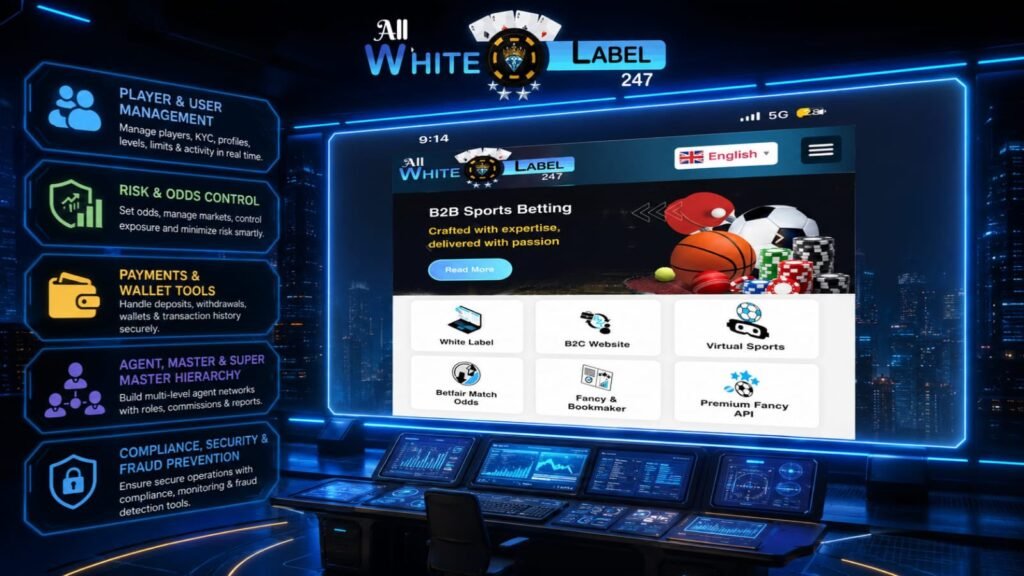
31 Revenue-boosting tools for faster growth, smarter risk control, and scalable white label operations. All White Label 247 Industry Guide See the two sportsbook owners. Both launch in the same month. Both spend the same money on marketing. Six months later, one is signing new agents every week. The other is stuck fixing errors, chasing fraud and losing players to slow payouts. The difference was never the odds. It was never the logo, the website or even the marketing budget. The real difference sat quietly behind the scenes and inside the admin panel. An admin panel is the control room of a betting business. It is where you set limits, watch risk, approve payouts, manage agents and catch fraud before it costs you money. A weak admin panel slows you down every single day. A strong one lets you scale to thousands of players without adding stress. This guide breaks down all 31 admin panel features a modern sportsbook or casino operator needs in 2026. You will get explanations, a buying checklist, common mistakes to avoid and a clear framework for choosing the right white label technology partner. What Is a Sportsbook Admin Panel? A sportsbook admin panel is the control dashboard that lets an operator manage every part of a betting business, like players, agents, odds, payments, risk and reports, from one place. It gives owners real-time control over the entire platform without touching a single line of code. Think of it like the cockpit of an airplane. The plane can fly fast and look great but the pilot still needs working controls to steer it, slow it down or change direction. Your betting platform is the plane. Your admin panel is the cockpit. Every action on your platform — a new signup, a bet placed, a withdrawal request, a bonus claimed — flows through the admin panel first. If that system is slow, confusing or missing key tools, your whole business feels it. Why Your Admin Panel Decides Whether You Win or Lose in 2026 In 2026, betting operators compete on speed, trust and control, not just odds. An admin panel with strong risk tools, fast payments and clear reporting directly increases profit margins, while a weak one causes fraud losses, slow payouts and unhappy agents who eventually leave. Betting is a numbers game. Small edges add up fast. A platform that spots a suspicious betting pattern in seconds instead of hours can save thousands of dollars in a single week. A platform that lets agents onboard players in minutes instead of days grows faster than one that cannot. This is why serious operators now treat the admin panel as a business asset, not just software. The right features turn daily operations into a smooth, almost automatic process, freeing you to focus on growth, marketing and player experience. The 31 Admin Panel Features Every Operator Needs The 31 essential admin panel features fall into six groups: player and user management, risk and odds control, payments and wallet tools, agent hierarchy management, compliance and security, and reporting with automation. Together, these tools give operators full control over growth, risk and profit. 1. Player & User Management This is where every player relationship begins. Good tools here mean faster onboarding, fewer support tickets and happier customers. 2. Risk & Odds Control This is the part of the admin panel that protects your profit margin every single day. 3. Payments & Wallet Tools Slow payments are the number one reason players leave a betting platform. These features fix that. 4. Agent, Master & Super Master Hierarchy If you run a network of agents, this is the backbone of your business. 5. Compliance, Security & Fraud Prevention This is the group most new operators underestimate until it costs them. 6. Reporting, CRM, Automation & Growth Tools These tools turn raw data into decisions and turn one-time players into loyal customers. Feature Comparison: Must-Have vs Nice-to-Have vs Advanced Not every operator needs all 31 features on day one. This table separates the non-negotiable basics from the tools that become important as your business scales. Admin Panel Capability Basic Turnkey Solution (Nice to Have) All White Label 247 Admin Suite (Advanced) Agent Downline Depth Flat single-level structure Infinite multi-tier hierarchies (Master, Super Master) Risk Assessment Time Delayed batch updates (10-15 mins) Sub-second live calculations and auto-adjustments Payment Integration Single regional gateway, manual routing Dynamic multi-chain crypto + localized smart routing API RTP Manipulation Risk Static, hidden backend structures Transparent live monitors with direct aggregate tracking Alert Systems Basic emails, no dynamic triggers Automated Telegram and SMS alerts with real-time severity levels Admin Panel Buying Checklist Before You Sign With Any Provider Before choosing a white label sportsbook or casino provider, operators should confirm that real-time risk tools like KYC/AML compliance, transparent commission structures, API flexibility and 24×7 technical support are included, not sold as costly add-ons later. Common Mistakes Betting Operators Make When Choosing an Admin Panel The most common mistakes operators make are choosing platforms based on price alone, ignoring risk management tools, underestimating compliance needs and signing with providers who lack scalable agent hierarchy support. Mistake 1: Choosing the cheapest option. A low setup fee often means missing risk tools, weak support and hidden costs later. Cheap admin panels tend to get expensive fast through fraud losses and slow payouts. Mistake 2: Ignoring agent hierarchy needs. Operators who plan to grow through agents but choose a platform without proper master and super master panel support end up rebuilding their entire structure later. Mistake 3: Underestimating compliance. Skipping KYC and AML tools to launch faster is a short-term win and a long-term risk, especially as regulated markets expand across new regions. Mistake 4: Overlooking support availability. Betting never sleeps. A provider without round-the-clock technical support leaves you exposed during exactly the moments — big matches, high traffic — when problems are costliest. 2026 Trends Shaping Sportsbook Admin Panels In 2026, admin panels are shifting toward automation-first design, AI-assisted fraud detection, deeper regional
How to Start an Online Betting Business in 2026: The Complete Step-by-Step Blueprint for Launching a Profitable Sportsbook & Casino Platform Without Building Everything from Scratch

By the All White Label 247 Editorial Team. Updated for 2026. Imagine launching your own betting platform in weeks instead of spending millions building software from scratch. No army of developers. No eighteen-month wait. No guessing whether your payment system will even work on launch day. That’s not a fantasy. It’s exactly what white label sportsbook technology has made possible in 2026. Entrepreneurs who once needed a Silicon Valley budget to enter the online gambling industry can now license a ready-built sportsbook and casino platform, slap on their own brand and go live before their competitors finish their first investor pitch. Right now, thousands of entrepreneurs across Asia, Africa and Europe are asking the same question: is it actually possible to own a sportsbook without a tech background or a venture-capital-sized budget? The honest answer is yes — and the path to get there is more straightforward than most people assume once you see it laid out step by step. This guide walks you through the entire process, from picking your niche to scaling a multi-agent empire using the exact framework serious operators follow in 2026. Grab a coffee. Let’s build your betting business. How to Start an Online Betting Business in 2026 To start an online betting business in 2026, choose your niche, secure the right licensing for your target market and partner with a white label sportsbook and casino provider like All White Label 247. This gives you ready-built software, a Master Panel, payment integration and risk management tools — so you can launch in weeks instead of building everything from scratch. The Step-by-Step Blueprint Starting a sportsbook isn’t one giant leap. It’s ten manageable steps. Treat this like a checklist and you’ll avoid the chaos most first-time operators run into. Step 1: Choose Your Betting Niche Every strong sportsbook starts with a clear identity. Are you building a cricket-first platform for South Asian markets? A football-focused brand for Europe? A crash-game and casino hybrid for younger mobile players? Picking a niche early shapes everything downstream — from your odds provider to your marketing content. A cricket betting platform launching right before IPL season, for example, can ride a massive wave of seasonal search traffic and betting interest. Niche selection also affects your agent strategy. A cricket-focused platform naturally attracts agents with existing cricket communities, while a casino-first brand draws agents connected to slot and live-dealer audiences. Matching your niche to the agents already active in that space accelerates your first hundred players. Action step: Write down your top three target markets and rank them by betting demand before you touch any software. Step 2: Understand Licensing & Compliance Licensing is not the exciting part of the blueprint — but it’s the part that keeps your business alive. Requirements differ by country and operating without proper compliance can shut a platform down overnight. KYC (Know Your Customer) checks, responsible gambling tools and anti-money-laundering processes aren’t optional extras. They’re the foundation that lets you operate with confidence and build player trust. Think of compliance the way a restaurant owner thinks about food safety inspections. It’s not the fun part of opening the doors — but skip it and the whole business can be shut down in a single afternoon. Building it in from day one instead of retrofitting it later saves both money and reputation. Action step: Talk to your white label provider early. Established providers have already navigated compliance frameworks across multiple jurisdictions and can point you toward the right path. Step 3: Select a White Label Platform This is the single biggest decision in your entire launch. A white label platform is pre-built sportsbook and casino software that you brand as your own, instead of coding everything from zero. Look for a provider offering a stable odds feed, a proven Master Panel, mobile-ready design and real customer support. All White Label 247 packages all of this into one turnkey gaming solution built specifically for entrepreneurs entering the iGaming business. Action step: Ask any provider for a live demo of their Master Panel before signing anything. Step 4: Set Up Sportsbook & Casino Products Once your platform is chosen, it’s time to configure what players actually see and bet on — sports markets, live betting, casino slots, live dealer tables and trending crash games like Aviator. A platform that blends sportsbook and online casino products under one login keeps players engaged longer. They can move between a football match and a live casino table without leaving your brand. Action step: Launch with a focused product mix first, then expand game categories once you understand what your players actually use. Step 5: Integrate Payments Players will abandon a betting site in seconds if deposits or withdrawals feel slow or unsafe. A modern payment gateway needs to support local bank transfers, e-wallets and increasingly, crypto payments. Fast payouts build trust faster than any marketing campaign ever could. A player who gets paid quickly after a big win becomes your best word-of-mouth advertisement. Action step: Prioritize payment methods your specific target market already trusts and uses daily. Step 6: Configure Master Panel & Agent Panels Your Master Panel is command central for your entire operation. From here, you manage odds, monitor transactions, oversee agents and control risk settings. Agent Panels sit beneath it, letting your agents manage their own player networks. Think of the Master Panel as the cockpit and the Agent Panels as regional control towers — each one feeding activity back up to you. Action step: Set clear commission and credit rules in your Master Panel before onboarding your first agent. Step 7: Set Risk Management Rules Risk management protects your bankroll. This means setting betting limits, monitoring unusual odds movement and flagging suspicious account activity before it becomes a real loss. A single unmonitored high-stakes bettor exploiting a pricing error can wipe out weeks of profit. Strong risk tools catch that before it happens. Good risk management isn’t about being restrictive for the sake of it —
FIFA World Cup 2026: Which Nations Will Dominate the Pitch and Which Betting Businesses Will Win the Digital Race?

A Complete AllWhiteLabel247 B2B & B2C Analysis See with me. Sixteen stadiums roar at the same moment. Flags wave from London to Delhi, from Lagos to Los Angeles. A striker fakes left and rockets the ball into the top corner. The crowd explodes. Across the planet, millions of phones light up in that exact second as live odds shift. New bets fly in. A father in Kolkata, a student in Toronto and an office worker in Manchester are all watching the same goal. Feeling the same heartbeat. This is FIFA World Cup 2026. And it is quietly changing two games at once: football and the online betting business built around it. The Biggest Football Festival on Earth Has Arrived FIFA World Cup 2026 is the 23rd edition of football’s biggest tournament. Jointly hosted by the United States, Canada and Mexico from June 11 to July 19, 2026. For the first time ever, 48 nations are competing across 104 matches in 16 host cities, making it the largest World Cup in history. Forget everything you knew about a normal World Cup. This one is bigger, louder and longer. Twelve groups, forty-eight teams and a brand-new round of 32 that never existed before. More goals, more shocks, more drama, packed into 39 unforgettable days. The opening match kicked off at the legendary Estadio Azteca in Mexico City and the tournament closes at the New York New Jersey Stadium on July 19. Estimates point to roughly six billion viewers worldwide — the single biggest sporting event humanity has ever shared. Which Nations Could Dominate FIFA World Cup 2026? Everyone wants the same answer. Which team can win FIFA World Cup 2026? Nobody knows for sure and that uncertainty is exactly what makes World Cup betting trends so thrilling. A handful of nations look built to peak at the perfect time. Argentina: Unfinished Business Lionel Messi, 38, may be playing his last World Cup. He opened it like a man chasing one fairy tale, scoring a hat-trick in a 3-0 win over Algeria. With Julian Alvarez, Lautaro Martinez and coach Lionel Scaloni, Argentina is a top pick to go back-to-back. France: Mbappe Looks Unstoppable Kylian Mbappe scored twice, one a stunning solo run, as France opened with a win over Senegal. Bookmakers list him as the favourite for the Golden Boot. Didier Deschamps brings tournament-tested calm to a squad built for deep runs. England: New Manager, Old Hunger Thomas Tuchel has added structure to a talented Three Lions squad. Harry Kane, fresh off a 61-goal club season, is a Golden Boot favourite. While Jude Bellingham and Bukayo Saka add creativity in a manageable group with Croatia, Ghana and Panama. Brazil: Rebuilding Their Rhythm Vinicius Junior leads a Brazil side still settling after a 1-1 draw with Morocco. With Endrick and deep attacking reserves, few teams shift gear faster once the knockout rounds begin. Spain: Ranked Number One Spain enters as FIFA’s top-ranked nation, led by teenage star Lamine Yamal. A cautious 0-0 draw with Cabo Verde will not worry coach Luis de la Fuente. His squad depth, including Mikel Merino and Mikel Oyarzabal, runs deeper than most rivals. Portugal: One Last Ride for Ronaldo Cristiano Ronaldo, likely playing his final World Cup, leads a Portugal squad blending experience with rising stars like Gonçalo Ramos in Group K, leaning on big-game know-how through the early rounds. Germany: A Statement Opener A 7-1 demolition of Curaçao announced Germany’s intent. With Florian Wirtz, Jamal Musiala and Kai Havertz driving the attack, Die Mannschaft stay dangerous whenever the stakes rise. So, which country is strongest? Spain holds the top FIFA ranking, but rankings do not lift trophies. Form and nerve under pressure decide everything. That uncertainty is exactly why football betting traffic explodes every World Cup. The Hidden Winner of FIFA World Cup 2026: The Betting Industry How will FIFA World Cup 2026 impact online betting? FIFA World Cup 2026 is projected to push global betting handle toward 36.9 billion dollars, with more than 12 million new betting accounts opened worldwide. The expanded 48-team format, 104 matches and convenient North American kickoff times are driving record traffic, live betting volume and mobile wagering activity. While 48 nations chase the trophy, a quieter race unfolds on phone screens everywhere. US sportsbooks alone could handle 2.82 to 4.3 billion dollars — nearly nine times the Qatar 2022 legal handle. With about 60 percent of fans worldwide planning to bet online or via mobile app, one trading network processed over 153 million bets during Qatar 2022. With 40 extra matches this year, that figure will be smashed, and a World Cup period can deliver 20 to 30 percent of a sportsbook’s annual revenue in just 39 days. Can sportsbook operators earn more during FIFA World Cup 2026? Absolutely. Registrations spike, live in-play betting surges with every kickoff and mobile demand hits its yearly peak. Fans who enjoy betting during the tournament often stay active long after the final results. Why is FIFA World Cup 2026 important for sportsbook operators? It concentrates a year’s worth of fan excitement into 39 days, letting sportsbook operators capture new players, lift lifetime value and test new regional markets while football betting traffic peaks. Why White Label Sportsbooks Could Win the Digital Race New operators learn the hard way. Building a sportsbook from zero takes years and millions of dollars, and a World Cup will not wait. This is exactly where white label sportsbook solutions change the equation. Faster launch: Go live in weeks, not years. Cost is where this really pays off too. Skip the years-long build phase entirely. Suddenly there’s actual budget left over for marketing instead of burning it all on development. Scalability: It matters just as much, since a normal weekend during the World Cup might throw ten matches at a platform all at once, and the infrastructure either holds up or it doesn’t. Risk management: Isn’t optional either — the trading tools built into a proper white label setup are
The IPL 2026 Rush: Why 90% of New Sportsbooks Crash During Playoffs
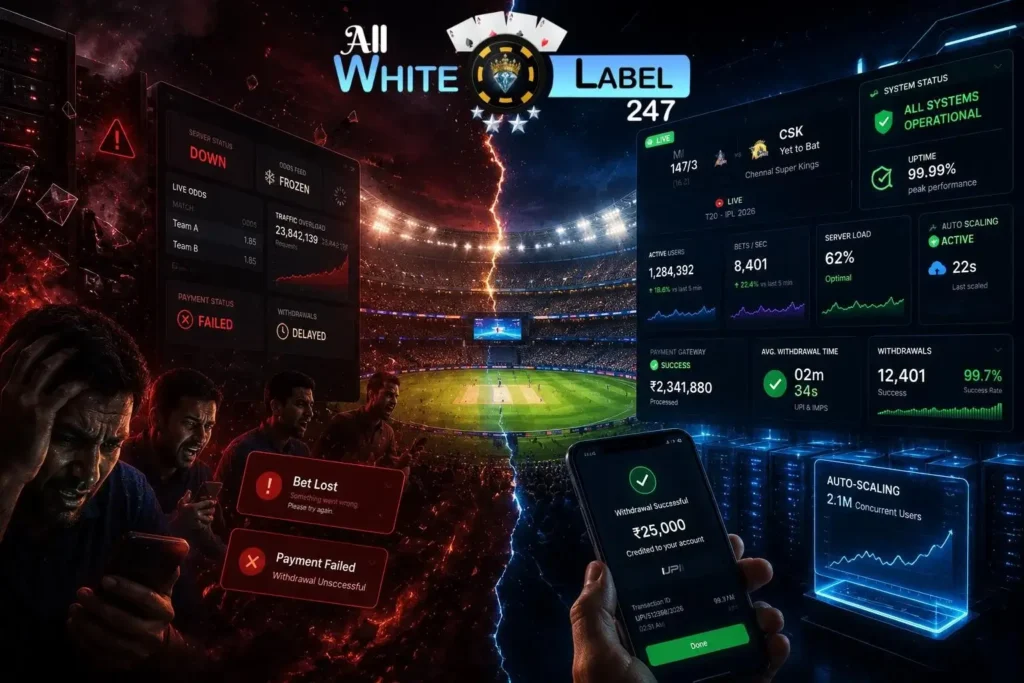
For: Sportsbook Founders, Gaming CEOs & Betting Platform Operators Introduction: The Night Everything Broke It is 9:47 PM. Mumbai Indians need 18 runs off the last over. Your sportsbook just crossed 800,000 active users. The in-play market is moving every 3 seconds. Then your server times out. Odds freeze at old numbers. Users hammer the refresh button. Withdrawal requests pile up. Customer support gets buried. And somewhere at exactly the wrong moment, your platform goes dark. This is not a hypothetical. This is what happens to roughly 9 out of 10 new sportsbooks when IPL playoff traffic hits at full force. IPL 2026 is already shaping up to be the biggest betting season in South Asian history. We are talking about 3.2 million concurrent users during peak playoff moments. Live betting markets moving on every single ball. UPI transactions firing every millisecond. And data flowing at speeds most new platforms were simply never designed to handle. Here is the uncomfortable truth: most sportsbook founders think they are ready. They have done the math. They have stress-tested their servers. They have spoken to their tech team. But IPL traffic does not behave like ordinary traffic. It does not build gradually. It explodes. This blog breaks down exactly why that happens, what it costs you when it does, and how white-label infrastructure from AllWhiteLabel247 is built to survive and thrive under that pressure. The 3 Ways IPL 2026 Breaks New Sportsbooks The Traffic Tsunami: Your Servers Were Not Built for This Picture your typical traffic curve. It builds through the day. Peaks in the evening. Falls off after midnight. Predictable. Manageable. IPL does not work like that. When a 200-plus run chase goes down to the wire, like we saw in IPL 2025 playoff finals, traffic does not build. It detonates. In documented infrastructure case studies from comparable cricket markets, platforms have recorded spikes from 120,000 to over 1.9 million concurrent users in under six minutes. Most new sportsbooks are provisioned for peak. Not for peak-times-ten. Here is what happens when your servers can not keep up: Page load times go from 1.2 seconds to 14 seconds. Session drops accelerate. Users exit after 8 seconds of lag. Live bet submission failures begin registering above 12%. Customer trust evaporates instantly and it does not come back. The worst part? You do not always know you are failing. Your monitoring dashboard might still show green. But your users are already on a competitor’s app. Odds Latency: The Invisible Revenue Killer Live betting is the heartbeat of IPL wagering. Every ball matters. A wide. A six. A wicket. The odds shift in real time and your platform has to shift with them. If your odds engine has even 200 milliseconds of latency, professional bettors exploit it. They see value before your platform corrects itself. You take losses on every single event. Repeatedly. Across thousands of markets. Across the entire tournament. If your odds latency goes above 500 milliseconds, which is shockingly common under high load? your entire live market becomes a liability instead of a revenue source. The benchmark you need to be at: sub-100ms odds delivery, every ball, under full tournament load. Anything slower is leaving money on the table or handing it directly to arbitrage bettors. Payment Gridlock: The Problem That Costs You Everything Indian bettors expect fast deposits and same-day withdrawals. That is the market reality in 2026. UPI has made instant payments the standard. Your platform is expected to match that. But under IPL playoff load, payment infrastructure buckles before server infrastructure does. Here is why: UPI gateway APIs have rate limits and most platforms hit them. Multiple payment processors competing for the same API slots create queue backlogs. Withdrawal requests spike 340% in the final overs of a close match. If a withdrawal takes more than 4 hours, you get chargebacks, disputes, and social media blowback. One viral post about “withdrawal stuck for 2 days” during IPL playoffs can destroy six months of brand-building overnight. The platforms that survive IPL are the ones that have multi-gateway UPI routing automatically switching between providers when one hits capacity. Most new sportsbooks have one gateway. One point of failure. Build vs. Buy: The $300,000 Mistake Every founder considers building in-house. It feels like control. It feels like ownership. But after you sit down and actually add up the numbers, the picture changes fast. Here is an honest comparison of what it actually costs and takes: Factor In-House Build AllWhiteLabel247 Initial Cost $200,000 – $400,000+ Fraction of build cost Time to Launch 12 – 18 months 30 days or less Core Team Needed 15+ engineers 0 (fully managed) Infrastructure Risk Very high Near zero Compliance Framework Build from scratch Pre-certified (GLI) Payment Integration Custom API build Multi-gateway, live day 1 Odds Engine Build + calibrate Sub-100ms, pre-deployed Auto-Scaling Manual config + DevOps Automatic, server less IPL Load Ready Unlikely without 6 months prep Proven at 2.1M+ concurrent Maintenance Overhead Ongoing high cost Fully managed by AWL247 The $300,000 mistake is not just the money. It is the time. It is the missed IPL window. It is the team you had to hire and fire. It is the users you lost while your engineers were still debugging payment web hooks at 2 AM. The smart operators figured this out early. They stopped trying to build the infrastructure. They started focusing on what actually grows a sportsbook marketing, acquisition, retention and brand. And they let AllWhiteLabel247 handle the engine underneath. How AllWhiteLabel247 Is Built for IPL Scale This is not marketing language. This is engineering reality. Every component of the AllWhiteLabel247 platform was stress-tested against IPL-scale scenarios. Not theoretical scenarios. Actual simulated playoff traffic → from 100,000 concurrent users to 2.1 million → in controlled load environments. Here is what that looks like under the hood: Auto-Scaling Cloud Infrastructure The platform deploys on cloud architecture that detects traffic spikes and provisions new capacity automatically in under 30 seconds. No manual